

Transforming Fur: Classifying and Processing
By Sara Schelstraete, Rosalie Schepers, Lien Mary and Silke Palmans
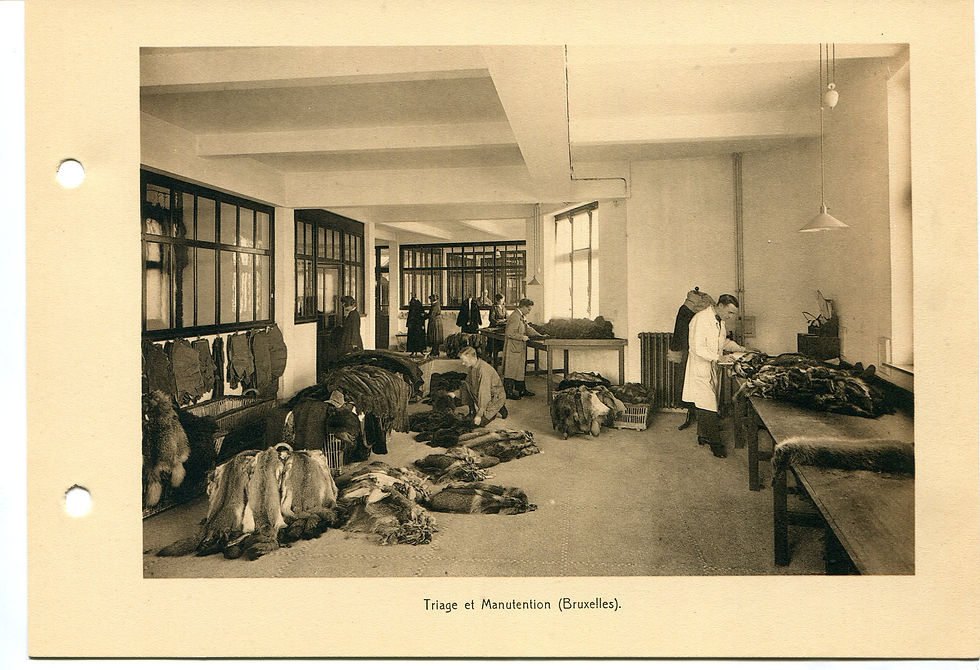
Classifying Fur:
The Belgian fur trade did not simply use animal skins; it sorted, named, ranked and (re)valued them. In this system, animals became legible as commodities through a language of classification. Their value was not fixed by the animal alone, but produced through the meeting of biology, materiality, commerce, fashion and other forms of human intervention.
This process of classification was both practical and symbolic. It allowed merchants, furriers and customers to not only distinguish between materials and establish hierarchies of ‘quality’, but also to translate animal bodies into commercial language. Yet classification was never neutral. It was a way of assigning value to biological life and transforming the visible and tactile properties of animals into signs of desirability.
Historical Belgian fur catalogues and associated literature reveal a broad range of animals used in the industry. These included caracul lamb, martens, otters, weasels, ferrets, ermine, mink, foxes, wolves, chinchillas, beavers, squirrels, muskrats, bears and tigers, among others. A skin might be identified by species, geographical origin, colour, texture, treatment, or the name under which it was sold. Scientific classification and commercial classification therefore overlapped, but they did not always coincide.
Materiality played a central role in this valuing system. Fur was assessed through close sensory attention. Different animal skins were valued for being dark, soft, long-haired, fine, glossy, warm, dense, rare or evenly coloured. Alaskan, Canadian, and Virginian otters, for example, were described as especially valuable, while the black variant of sea otter was valued for its rarity. Among martens, darker coats from northern European regions were particularly prized. Sable was valued for its long, shiny, fine hair and for the darker quality of its winter coat. Chinchilla was admired for softness and warmth; ermine for the whiteness of its winter fur and its black tail tip; silver fox for the interplay of its long black and white hairs.
The continuous supply of specific ‘types’ of fur was also not consistent or stable. Fur retained the marks of animal life, and its qualities changed according to geography, season, age and bodily condition. Geography could affect tone and texture; season could alter colour, density and length; age could transform both appearance and commercial category. The distinction between “Breitschwanz” and “Persianer” fur, for example, depended on the age and developmental stage of the caracul lamb. Thus, even though a skin could be sorted into a type, it still required individual assessment. Classification therefore helped organise animal matter, but it could never really standardise it.
The fur trade also invented its own commercial names and distinctions. Grey squirrel fur could be sold as petit-gris when only the back was used, or as vair when the whole skin was used; its colour variants were further classified as petit-gris bleu, petit-gris noir, or petit-gris blanc. Such distinctions therefore remind us of the instability of classification itself: categories were not fixed in the animal body itself, but made through human systems of use, naming and value.
The catalogues and classifications preserved from the Belgian fur trade are therefore more than technical records. They show how humans organised, valued, and transformed animal matter. They reveal a system in which biological difference was made commercial through naming and comparison, and in which luxury depended on the material qualities of once-living bodies.
By paying attention to classification, we can understand the fur trade not only as a history of fashion, but also as a history of human-animal relations. Its categories show how animal bodies were made readable as materials and desirable as commodities, while still retaining traces of the lives and the conditions from which they came. Fur occupied a shifting position between animal body, worked material, and luxury good; it was in that passage that its value was ascribed.
Processing Fur:
The manufacture of historical fur garments involved multiple steps, techniques, and tools, but these processes did more than produce clothing. They reorganised animal bodies into wearable objects. Skin, hair, colour, texture, and shape were worked through a series of material changes: some traces of the animal were hidden, some were altered, and others deliberately preserved. The making of fur garments therefore involved three related operations: concealment, substitution, and display. These operations shaped what a fur garment was: an object made from animal bodies, but no longer corresponding to any single body in a straightforward way.
Before fur could be cut and sewn, the animal skin first had to be made workable. After the animal was slaughtered and skinned, the hide was fleshed to remove remaining tissue and membranes. It was then tanned, making the skin flexible, durable and resistant to decay. Dyeing could further alter the surface, producing a more even colour or changing the appearance of the pelt. Fleshing, tanning and dyeing gave the pelt durability, but it also altered the visibility of the animal, recasting it as a matter of surface, colour and texture.
Garment-making continued this reorganisation. Pelts were selected for colour, hair length, texture, and quality, then blocked, cut, joined, and sewn into the desired form. A single coat or stole might contain skins from several animals, and sometimes from different species, when their visual properties allowed them to be combined. The finished object was therefore rarely the simple continuation of an individual animal body. It was a constructed surface, assembled from parts whose distinct origins were increasingly difficult to discern.
This reorganisation depended on careful acts of visual management. Skins had to be arranged so that variations in colour, density and texture did not disrupt the appearance of continuity. Cutting and sewing required precision, particularly because the leather side had to be worked without damaging the hair. Fur-sewing machines were used for many seams, while other areas required handwork. Specialised techniques such as volvel, dedoubleren, mariëren, galonneren, intercaleren, and allongeren shaped the structure, fit, and appearance of the garment. Through this labour, seams were minimised, variations absorbed, and multiple animal bodies reworked as a single wearable form.
Substitution formed another essential part of fur manufacture. Animal pelts were dyed or treated to resemble more expensive varieties, allowing one kind of skin to be recognised and sold through the qualities of another. Species, value and desirability were thus carefully constructed through surface treatment and renewed classification. In such instances, a garment
presented one material identity while containing another animal origin.
Yet concealment and substitution were never complete. In the finished garment, it could be difficult to identify how many animals had been used, where one pelt ended and another began, or how far the skins had been altered. Still, hair direction, markings, joins, and irregularities could register the presence of animal bodies without revealing them fully. However carefully worked, fur resisted full regularisation.
Other garments made this tension more explicit. Rather than suppressing signs of the animal, they incorporated tails, heads, paws, claws, or other taxidermic elements precisely because these parts remained recognisable. Fashion did not restore the animal body in these cases; it used selected parts of it.
The transformation of animal bodies also depended on close manual labour. Historical depictions of Belgian fur manufacturing suggest a gendered division of labour, with men more often shown standing at preparatory work and women seated at sewing or finishing. This pattern should not be read as absolute, but it indicates how gender shaped not only the allocation of tasks, but also the bodily conditions of work: posture, movement, proximity to tools, and exposure to materials. It also reminds us that fur manufacture was physically demanding work, exposing both men and women, though often in different ways, to dust, animal hair, and hazardous chemicals.
How, then, should such garments be understood? Perhaps fur objects are best understood as reimagined assemblages. Their force as objects lies in the fact that they do not settle neatly into one category. They are garments, but also remnants; surfaces, but also skins; ornaments, but also reorganised animal bodies. Their meaning lies partly in what they withhold: an intimacy with animal bodies made wearable, but only partially recognisable.
Bibliography:
Bachrach, Max. Fur: A Practical Treatise. New York: Prentice-Hall, 1946.
Beltzer, Francis J.-G. Industries des poils et fourrures cheveux et plumes. Paris: Dunod, 1928.
Bonthond, J. T. Woordenboek voor den manufacturier: stofnamen en vakuitdrukkingen. Groningen: Wolters, 1943.
Chandrasekaran, Vidhyalakshmi. “Substitution of Hazardous Chemicals in Fur Processing Industry.” Master’s thesis, Kaunas University of Technology, 2018.
Chen, Jie, et al. “Environmental Mycological Study and Respiratory Disease Investigation in Fur Processing Workers.” Journal of Occupational Health 45, no. 4 (2003): 238–41.
Churchill, James. The Complete Book of Tanning Skins and Furs. Mechanicsburg, PA: Stackpole Books, 1983.
De Groot, Sabine. “My Name Is Bont.” Driemaandelijks Tijdschrift voor Industriële Cultuur 72, no. 4 (2000).
Harding, Arthur Robert. Fur Farming: A Book of Information About Fur Bearing Animals, Enclosures, Habits, Care, etc. Columbus, OH: A. R. Harding Publishing Co., 1909.
Macdonald, David W., ed. The Princeton Encyclopedia of Mammals. Princeton, NJ: Princeton University Press, 2009.
Schwebke, Phyllis W., and Margaret B. Krohn. How to Sew Leather, Suede, Fur. New York: Simon and Schuster, 1970.
Warwick, C., et al. “One Health Implications of Fur Farming.” Frontiers in Animal Science 4 (2023).
Archival Sources:
Catalogue A. Maertens-Bertrand, Gand, Hiver 1911–12, 1911, Vliegende Bladen, Ghent University Library, inv. no. HFIII.F.004.16.
Catalogue Ch. Muller, Bruxelles, Hiver 1910–1911, 1910, Vliegende Bladen, Ghent University Library, inv. no. HFIII.F.004.14.
Catalogue Fourrures Au Bon Marché, Vaxelaire-Claes, Bruxelles, hiver 1909–1910, 1910, Vliegende Bladen, Ghent University Library, inv. no. HFIII.F.004.14.
Catalogue Grands Magasins de la Bourse, Bruxelles, Fourrures 1911–12, 1911, Vliegende Bladen, Ghent University Library, inv. no. HFIII.F.004.16.
Catalogue R. Mallien Fourrures, saison 1912/13, 1912, Vliegende Bladen, Ghent University Library, inv. no. HFIII.F.004.14.
Catalogue S. Van Gheluwe, Grands Magasins du Beffroi, Gand, Hiver 1907–1908, 1907, Vliegende Bladen, Ghent University Library, inv. no. HFII.F.006.24.
Catalogue S. Van Gheluwe, Saison d’Hiver 1909–1910, Au Beffroi. 1909, Vliegende Bladen, Ghent University Library, inv. no. HFII.F.006.24.